
🧠 Learning Science · Study Strategy · Student Performance 2026
Smart Study Secrets:
Master High-Performance Learning Techniques

Most students study long hours using techniques that science has proven to be almost completely ineffective. This guide reveals the exact cognitive strategies that top performers use to retain more, score higher, and study less — all backed by 100+ years of memory research.
🔁 Active Recall⏱ Spaced Repetition🎯 Feynman Technique⚡ Parkinson’s Law🧬 Forgetting Curve🤖 AI Study Tools
📋 What You’ll Learn in This Guide
- The biggest myth killing students’ grades right now
- Harness the biology of memory: active recall & spaced repetition
- Beat the Ebbinghaus forgetting curve with the right schedule
- Strategic content prioritization: the 80/20 rule for studying
- The Feynman technique: the most powerful learning shortcut
- Parkinson’s Law & the Pomodoro Technique: how to focus on command
- Interleaving: why mixing subjects beats marathon sessions
- Optimize your environment and brain fuel for peak performance
- The deep focus ritual: how Japan’s “Sue” principle works
- Leverage AI tools for smarter studying in 2026
- Frequently asked questions
Here is the uncomfortable truth about how most students study: re-reading and highlighting ranked as “low utility” in a landmark review published in Psychological Science in the Public Interest — yet they remain the most commonly used study methods in schools across America and the world.
Meanwhile, studies from Washington University in St. Louis and UCLA confirm that active learning is dramatically more effective than passive learning. Students using science-backed techniques retain up to 200% more information compared to those using traditional re-reading methods. Spaced retrieval practice alone produces approximately 150% better long-term recall than massed study, according to Karpicke and Roediger’s landmark 2008 study published in Science.
200%
More retention in students using science-backed vs. traditional methods
70%
Of new information is lost within 24 hours without reinforcement
150%
Better long-term recall from spaced retrieval practice vs. re-reading
86%
Of college students now use AI as their primary research partner in 2026
Myth-BustingThe biggest myth killing students’ grades right now
The single most damaging belief in student culture is that more hours = better results. It doesn’t. Research consistently shows that 4 focused, technique-driven hours outperform 8 distracted, passive hours every time. Students who track their study time honestly discover they overestimate actual focused time by 30–50%.
❌ What Most Students Do (Low Utility)
Passive Study Methods
- Re-reading chapters multiple times
- Highlighting textbooks in different colors
- Rewriting notes verbatim
- Listening to lectures passively
- Cramming the night before exams
- Reviewing what they already know
✅ What Top Students Do (High Utility)
Active Study Methods
- Active recall — testing from a blank page
- Spaced repetition at increasing intervals
- The Feynman Technique — teaching it back
- Interleaving multiple subjects per session
- Practice testing with real past papers
- Prioritizing weaknesses, not strengths
“Success is less about the number of hours studied and more about how those hours are used. Retrieval, spacing, interleaving, and focused sessions consistently outperform passive methods such as re-reading or highlighting.”— Study Techniques Research 2026 | Sugc.co.in / Multiple Cognitive Science Sources
Memory ScienceHarness the biology of memory: active recall & spaced repetition
Real learning is not about putting information into your brain through passive reading — it is about pulling information out. Every time you struggle to retrieve a memory, you strengthen the neural pathways in your neocortex that make that information easier to access next time. This is the fundamental neuroscience behind two of the most powerful study techniques known to cognitive science.
🔁
Active Recall
Close your book completely. From a blank page, write or say everything you remember about the topic. Don’t look at your notes. The struggle itself is the learning — it forces your brain to create strong, retrievable neural pathways. This is known as the “testing effect” in cognitive science.📊 Research: Active recall produces 200%+ better retention vs. re-reading (Roediger & Karpicke, 2006)
📅
Spaced Repetition
Review material at strategically increasing intervals — not all at once. Each spaced review “resets” the forgetting curve at a higher retention level, making the memory progressively more durable. The Leitner system and digital tools like Anki automate this scheduling precisely.📊 Research: Spaced retrieval practice = 150% better long-term recall vs. massed study (Karpicke & Roediger, 2008)
🔀
Interleaving
Instead of studying one subject for hours (blocked practice), cycle through 2–3 different subjects per session. This forces your brain to repeatedly re-engage and discriminate between topics — creating stronger, more flexible memory representations than blocked study ever can.📊 Research: Interleaved practice improves exam performance by 43% vs. blocked practice (Taylor & Rohrer, 2010)
🗺
Mind Mapping
Place a central concept in the middle of a blank page and branch out with related sub-topics, examples, and connections. The process of visually organizing information forces active processing and reveals gaps in understanding you didn’t know existed.📊 Research: Mind mapping shows 10–15% recall gains over linear note-taking (Medical Education Review, 2014)
✏️
Practice Testing
Take real past exams under timed conditions from the very start of your revision — not just as a final check. Knowing the exact question format and examiner’s preferred answers tells you what the 20% of content to prioritize actually looks like in practice.📊 Research: Practice testing outperforms all other study strategies for long-term retention (Dunlosky et al., 2013)
🎯
Targeted Weakness Review
Maintain an “error notebook” of every question you got wrong on practice tests. Review this list before every study session. Your brain naturally gravitates toward reviewing what you already know — because it feels good. The path to improvement is through your screw-ups.📊 Cognitive science: Reviewing errors targets the most efficient return-on-study-time of any technique
Memory ScienceBeat the Ebbinghaus forgetting curve with the optimal review schedule
In 1885, German psychologist Hermann Ebbinghaus conducted the first quantitative experiments on human memory, discovering what is now known as the Forgetting Curve. His findings — replicated consistently across 140 years of modern research — reveal a sobering truth: about 70% of new information disappears within 24 hours without reactivation. Without any review, learners forget up to 90% of new material within a month.
The Ebbinghaus Forgetting Curve — Memory Retention Over Time Without Review
100%
Day 0
(Learning)
58%
Day 1
44%
Day 3
36%
Day 7
21%
Day 14
10%
Day 30
⬆ Each spaced review “resets” the curve at a higher level — making forgetting exponentially harder over time
The solution is spaced repetition — reviewing material at precisely timed intervals just before the critical forgetting point. Cepeda et al. (2006) meta-analyzed 254 studies and found distributed practice beats massed practice for long-term retention across every condition tested.
Here is the optimal spaced repetition review schedule for any new material you learn, as supported by ScienceDirect’s 2026 research on spaced repetition and academic performance:
Review 1
Day 1
Within 24 hours — halts the steepest part of the forgetting drop
Review 2
Day 3
Resets memory at a higher baseline before the 3-day decay point
Review 3
Day 7
One-week review significantly flattens the long-term decay curve
Review 4
Day 14
Two-week mark — memory is now highly stable with minimal effort
Review 5
Day 21+
Monthly review. By this point, recall is near-permanent
Use Anki — the world’s most widely used spaced repetition flashcard system — to automate this schedule entirely. Anki’s SM-2 algorithm calculates the optimal review interval for each card based on your performance, so you never have to think about scheduling again.
StrategyStrategic content prioritization: the 80/20 rule for high-performance studying
High-performance students understand a counterintuitive truth: 80% of exam results come from just 20% of the material. Most textbooks are padded with context, background history, and tangential detail that rarely appear on exams. Identifying and eliminating this “fluff” before you begin studying saves dozens of hours of wasted effort.
80%
of textbook content contributes to only 20% of your exam marks
20%
of the right material produces 80% of your exam results — find it first
3 tactics to identify the high-value 20%
1
Read the chapter backwards — summary first
When starting a new chapter, begin at the summary, key points, and review questions at the end. Then do a quick “first pass” scanning only headings, diagrams, bold terms, and captions. This gives you a complete structural map of the chapter before reading a single paragraph — so when you do read, you already know what matters.
2
Study the answers before the content
Go directly to the questions and answers at the end of the chapter. Read all of them before reading the chapter. This tells you exactly what the examiner considers important — allowing you to mentally flag relevant content as you read and completely skip the irrelevant material. This is the fastest way to reverse-engineer exam performance.
3
Prioritize your weaknesses, not your strengths
The temptation to review material you already know is real — it feels productive and comfortable. Resist it completely. Tag concepts you don’t understand during lectures with a specific marker. During revision, tackle those flagged items first while your focus is sharpest. Your return on study time is highest where your knowledge is lowest.
TechniqueThe Feynman technique: the most powerful learning shortcut known to science
Nobel Prize-winning physicist Richard Feynman was famous for his ability to explain the most complex ideas in the simplest possible terms. His approach to mastering any concept became one of the most powerful and widely studied learning techniques in education research — and it works on any subject from organic chemistry to macroeconomics.
🧪
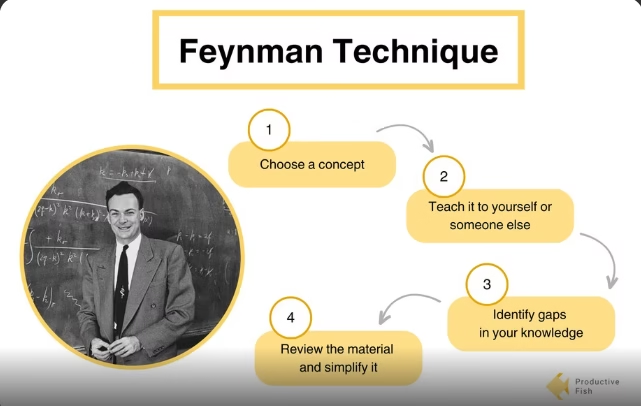
The Feynman Technique — 4 Steps
Step 1: Choose a concept from your notes.
Step 2: Write or speak an explanation of it as if teaching it to a complete beginner — a 5-year-old, your grandmother, your least science-minded friend.
Step 3: Identify every place where you used jargon, stumbled, or couldn’t explain clearly. That gap is your blind spot.
Step 4: Return to your source material specifically to fill those gaps, then re-explain from scratch.
The Feynman Technique forces your brain to organize information in a way that prioritizes deep understanding over surface-level familiarity. If you can explain a concept simply to a novice, you own it permanently. If you can’t — you’ve identified exactly what to study next, saving hours of undirected revision.
Research cited by StudyBoost’s 2026 study techniques guide confirms that the “teaching effect” — explaining material to others — is one of the most reliable methods for identifying knowledge gaps and strengthening long-term retention simultaneously.
ProductivityParkinson’s Law & the Pomodoro Technique: how to focus on command
The second-biggest productivity killer — after wrong study techniques — is unstructured time. Cyril Northcote Parkinson’s 1955 observation holds as true for studying as it does for corporate work: “Work expands to fill the time available for its completion.”
⚡
Parkinson’s Law Applied to Studying
Give yourself 3 hours to review a chapter, and you will take 3 hours — with significant time lost to passive re-reading, phone checking, and false productivity. Set a 30-minute timer for the same task and your brain shifts into urgent, high-stakes, full-focus mode. The artificial constraint creates the mental urgency that passive, open-ended sessions never will. The output per minute is dramatically higher.
The Pomodoro Technique: the timing framework that makes Parkinson’s Law work
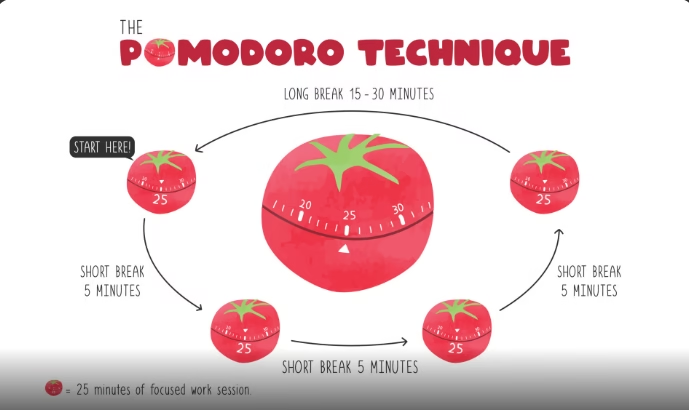
Developed by Francesco Cirillo in the late 1980s and validated by decades of productivity research, the Pomodoro Technique operationalizes Parkinson’s Law into a repeatable daily structure:
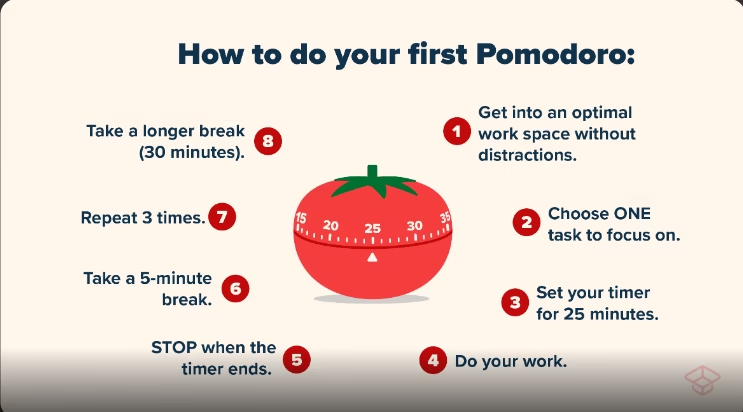
| Phase | Duration | What You Do | Why It Works |
|---|---|---|---|
| 🍅 Pomodoro 1 | 25 minutes | Single task, phone in another room, full focus | Creates urgency; prevents attention diffusion |
| ☕ Short Break | 5 minutes | Stand up, stretch, hydrate, walk briefly | Resets attention; boosts oxygen to brain |
| 🍅 Pomodoro 2 | 25 minutes | Continue or switch to related micro-task | Maintains momentum without burnout |
| ☕ Short Break | 5 minutes | Away from screens entirely | Consolidation happens during rest, not study |
| 🍅🍅 Pomodoros 3–4 | 25 min each | Tackle hardest material in your peak energy window | Willpower is highest in first 90 minutes |
| 🛌 Long Break | 20–30 min | Full disconnect — no screens, light activity | Prevents cognitive fatigue; resets for next block |
Batch similar tasks within the same Pomodoro block to minimize the “transition cost” — the cognitive overhead of switching between fundamentally different mindsets (like analytical math vs. essay writing). Start with your easiest fixed tasks (like flashcard review) to build momentum, then tackle variable high-cognitive tasks (like essay planning or problem-solving) at your peak.
NeuroscienceInterleaving: why mixing subjects dramatically outperforms marathon sessions
The conventional advice to “focus on one subject at a time” feels intuitive — but cognitive science says it produces significantly weaker long-term retention than interleaving. Interleaving means cycling through 2–3 different subjects or problem types within a single study session instead of spending the entire session on one topic.
Why does it work? When you switch subjects, your brain temporarily “forgets” the previous topic and must retrieve it again during the next switch — which is exactly the same strengthening mechanism as spaced repetition. The session feels harder and less smooth than blocked study, but that difficulty is the learning happening in real time.
🔬 The Research Behind Interleaving
Research from Edutopia and LearnDoGrow’s 2026 cognitive science review shows that students using spaced repetition and interleaved learning demonstrated an average increase of 30% in exam scores compared to students using traditional blocked study methods. The technique is particularly powerful for subjects requiring discrimination between similar concepts — like biology classification, math operations, or grammar rules in a foreign language.
Practical interleaving schedule for a 3-hour session: 40 min Math → 40 min Chemistry → 40 min History → 15 min break → 30 min Math (active recall) → 30 min Chemistry (Feynman technique) → 25 min History (practice questions). The variety prevents cognitive fatigue on any single subject while the returns to each topic function as built-in spaced repetition.
PerformanceOptimize your environment and brain fuel for peak cognitive performance
Your physical state directly determines your cognitive ceiling. No study technique can fully compensate for a dehydrated, sugar-crashed, distraction-saturated learning environment. These are the environmental factors with the strongest research-backed impact on study performance:
💧
Hydration
Your brain is approximately 75% water. Even mild dehydration (1–2% body water loss) measurably impairs concentration, short-term memory, and problem-solving ability.
✅ Drink a full glass of water before every session
📱
Phone = Enemy
Research shows that even having your phone visible but face-down reduces cognitive capacity. The mere presence of a smartphone drains available working memory through suppression effort.
✅ Put it in a different room — not on silent, not face-down
🥜
Brain Fuel
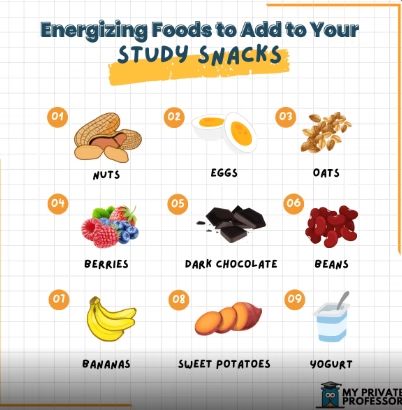
Sugar spikes → crashes → “brain fog” that destroys concentration for hours. Cognitive performance peaks on sustained-energy foods: nuts, fish, berries, eggs, and complex carbohydrates.
✅ Nuts and berries during sessions; avoid high-sugar snacks
🚶
Movement
Short walking breaks between Pomodoros increase cerebral blood flow, oxygen delivery to the hippocampus, and BDNF (brain-derived neurotrophic factor) — the protein that promotes new neural connections.
✅ 5-minute walk every 25–30 minutes minimum
😴
Sleep
Memory consolidation happens during sleep — specifically during slow-wave and REM phases. Pulling an all-nighter before an exam sacrifices the exact biological process that transfers learning from short-term to long-term memory.
✅ 7–9 hours minimum during revision periods
🌡
Temperature
Cognitive performance peaks at cooler ambient temperatures — approximately 70–72°F (21–22°C). Warm, stuffy rooms accelerate fatigue and reduce alertness within 30 minutes of studying.
✅ Keep your study space cool and well-ventilated
MindsetThe deep focus ritual: Japan’s “Sue” principle and the Kaizen approach
In Japan, students practice “Sue” — a state of deep, unself-conscious focus achieved not through willpower, but through specific pre-session rituals that signal to the brain that it is time to enter learning mode. The principle is backed by modern behavioral psychology: environmental cues trigger automatic behaviors, whether those behaviors are helpful or harmful.
①
Create your personal focus ritual
Use the same specific combination of actions before every study session: sit in the same chair, use the same pen, brew the same tea, light the same candle, put on the same instrumental playlist. Over time, these cues become so strongly associated with focused study that initiating the ritual automatically primes your brain for deep work. The ritual removes the decision fatigue of “getting started.”
②
Apply the Kaizen principle: 1% daily improvement
The Japanese concept of Kaizen — continuous, incremental improvement — is the antidote to perfectionism paralysis. Don’t try to transform your entire study system in one day. Instead, improve one thing by 1% each session: add five minutes to your active recall, reduce your phone glancing by one instance, add one new Anki card to your deck. Compounded daily, these micro-improvements produce massive results over a semester.
③
Reframe difficulty as the signal of learning
The most important mindset shift in high-performance studying: if it feels hard, it’s working. Active recall feels uncomfortable because you’re struggling to retrieve — and that struggle is the exact moment of learning. Passive re-reading feels easy because no new neural pathways are being created. Difficulty is not a sign you’re behind; it’s the biological signal that your brain is building durable memory.
2026 ToolsLeverage AI tools for smarter studying in 2026
86% of college students now use AI as their primary research partner in 2026. The way students study has changed more in the last two years than in the previous two decades. But there is a critical distinction between using AI as a crutch (which bypasses learning entirely) and using AI as a cognitive amplifier (which multiplies the effectiveness of the techniques above).
| AI Use Case | How to Use It | Technique It Amplifies | Tools |
|---|---|---|---|
| Flashcard Generation | Upload lecture notes → generate Anki-format Q&A cards automatically | Spaced Repetition | ChatGPT, Anki AI plugins |
| Socratic Tutoring | Ask AI to quiz you on a topic without giving answers — force retrieval first | Active Recall | ChatGPT, Claude, Khanmigo |
| Feynman Feedback | Explain a concept to AI in simple terms; ask it to identify gaps in your explanation | Feynman Technique | ChatGPT, Claude |
| Study Plan Creation | Input exam date + topic list → generate a spaced repetition-optimized revision calendar | Spaced Repetition + 80/20 | ChatGPT, NotionAI |
| Topic Summarization | Get a dense 200-word summary to use as an active recall prompt — not as replacement reading | Active Recall Prompt | Claude, ChatGPT, Gemini |
| Practice Question Generation | Ask AI to create exam-style questions at varying difficulty levels from your notes | Practice Testing | ChatGPT, Perplexity |
The most important AI study rule: always attempt active recall before asking AI for the answer. Use AI to check your work, identify gaps, and generate new practice material — not to replace the retrieval effort that makes learning permanent.
Quick StartYour high-performance study system: the complete daily checklist
🚀 The Smart Studier’s Daily Protocol
☀️Morning (Peak Energy): Tackle the hardest active recall or practice testing in your first 90-minute Pomodoro block — willpower and working memory are highest in the morning
🎯Set the Timer First: Before opening a single book, set a 25–30 minute Pomodoro timer. Parkinson’s Law: the timer creates the urgency that makes every minute count
📱Phone in Another Room: Non-negotiable. Not silent, not face-down — in another physical space entirely before every session begins
🔁Active Recall First, Notes Second: Begin each topic by writing everything you remember from a blank page. Compare against your notes only after the recall attempt
📅Review Yesterday’s Material First: Spend the first 5 minutes of each session on active recall of yesterday’s content — the Day 1 spaced repetition review that halts the steepest forgetting drop
🔀Interleave After the First Pomodoro: After 25 minutes on one subject, switch to a different topic for the next Pomodoro rather than continuing the same material
✏️Error Notebook Update: After every practice test or active recall attempt, add every incorrect or incomplete answer to your error notebook for tomorrow’s priority review
💧Hydrate and Walk Every Break: Glass of water + 5-minute walk for every break. Sleep 7–9 hours minimum during revision — memory consolidation requires it
Research sources & further reading on high-performance learning
↗ Anki — Free Spaced Repetition System↗ ScienceDirect — Spaced Repetition Research 2026↗ LearnDoGrow — Science-Backed Study Methods 2026↗ StudyBoost — 10 Proven Study Techniques↗ Athenify — Best Study Habits 2026↗ Cramd — 15 Evidence-Based Study Methods↗ Active Recalling — Complete Spaced Repetition Guide↗ Memia — Ebbinghaus Forgetting Curve Explained↗ Khan Academy — Free Learning Resources↗ NUM8ERS — Top 20 Science-Backed Study Techniques
FAQFrequently asked questions about high-performance learning techniques
What is the single most effective study technique for long-term retention?
Active recall combined with spaced repetition is the most powerful study technique backed by over 100 years of research. A 2008 landmark study by Karpicke and Roediger published in the journal Science found that spaced retrieval practice produced approximately 150% better long-term recall than massed re-reading. The key insight: every time you struggle to retrieve a memory, you strengthen the neural pathway that makes retrieval faster next time. Re-reading gives your brain no reason to strengthen those pathways. How does the Ebbinghaus forgetting curve affect my studying?
The Ebbinghaus forgetting curve reveals that without reinforcement, approximately 70% of new information disappears within 24 hours and up to 90% within a month. Understanding this allows you to time your reviews strategically — Day 1, Day 3, Day 7, Day 14, and Day 21 — intervening just before each critical forgetting point. Each spaced review resets the curve at a progressively higher retention level, making forgetting exponentially harder over time. This is why spaced repetition tools like Anki outperform all-night cramming sessions for long-term exam success. What is the Feynman Technique and how do you use it for studying?
The Feynman Technique involves four steps: (1) choose a concept from your notes; (2) explain it completely as if teaching a 5-year-old, using no jargon whatsoever; (3) identify every place you stumbled, used technical language automatically, or couldn’t explain clearly — these gaps reveal where your understanding is shallow; (4) return to your source material specifically to fill those gaps, then re-explain from scratch. If you can explain it simply, you own it. If you can’t, you’ve just identified exactly what to study next — which is far more efficient than unfocused re-reading. What is Parkinson’s Law and how does it help you study less?
Parkinson’s Law states that “work expands to fill the time available for its completion.” Applied to studying: open-ended, unscheduled study sessions allow your brain to drift into low-effort, passive activity — phone checking, re-reading, daydreaming — because there’s no urgency to perform. Setting a strict 25–30 minute Pomodoro timer forces your brain into urgent, high-stakes focus mode by creating an artificial constraint. The per-minute output of a timed session dramatically exceeds that of an open-ended one. Is it better to study one subject for a long time or switch between subjects?
Switching between subjects — called interleaving — produces significantly better long-term retention than studying one subject for a long block, despite feeling less comfortable in the moment. Research shows interleaved practice improves exam performance by approximately 43% compared to blocked practice. The reason: switching subjects forces your brain to re-retrieve the previous topic when you return to it, which provides built-in spaced repetition within the same study session. The “difficulty” of interleaving is the learning happening. How should students use AI tools for studying without replacing real learning?
The most effective AI study approach is to use AI as a cognitive amplifier — not a shortcut. Use AI to generate flashcards from your notes (for spaced repetition), create exam-style practice questions (for active recall), provide Feynman-style feedback when you explain concepts, and build optimized study schedules. The critical rule: always attempt active recall before asking AI for the answer. Never use AI to read or summarize content you haven’t engaged with first — that bypasses the retrieval effort that makes learning permanent. AI should make your study techniques faster to implement, not replace them.
🧠 Start Studying Smarter Today — Not Tomorrow
Download Anki, create your first 10 active recall flashcards, set a 25-minute Pomodoro timer, and put your phone in another room. That’s the entire system. Everything else is refinement.Get Anki Free — Start Your First Spaced Repetition Deck →
Related Articles
- How to Reduce Inflammation Through Diet: The Evidence-Based Guide
- How Your Gut Microbiome Controls Sleep: The Science Behind Better Rest and Better Health
- Natural Remedies for Better Sleep and Insomnia Relief
- How to Build a No-Equipment Home Workout Routine for Busy Professionals
- Home Remedies for Lower Back Pain Relief: Evidence-Based Exercises, Stretches, and Daily Habits
- Top Dermatologist-Approved Skin Care Home Remedies for Acne, Eczema, and Dry Skin