
How to Build a No-Equipment Home Workout Routine for Busy Professionals: The Evidence-Based Guide
Author: Health & Fitness Editorial Team — Content developed in consultation with licensed physical therapy and exercise science professionals.
Medical Disclaimer: This article is for informational purposes only and is not a substitute for professional medical advice. Consult your physician before beginning any new exercise program, particularly if you have a pre-existing cardiovascular, musculoskeletal, or other medical condition.
Quick Answer: You can build real strength and cardiovascular fitness with zero equipment in as little as 15–20 minutes per day, 3–4 times per week, using bodyweight resistance training and interval-based conditioning. Research published in the Journal of Sports Science & Medicine confirms that bodyweight circuit training produces comparable strength and cardiovascular improvements to equipment-based training in previously sedentary adults over a 6–8 week period. The key variables are consistency, progressive difficulty, and proper movement mechanics — not equipment access.
Table of Contents
- Why Busy Professionals Struggle to Exercise — And Why Equipment Isn’t the Real Barrier
- Is Bodyweight Training Actually Effective? What the Research Shows
- How to Build a No-Equipment Home Workout Routine: The Complete Framework
- The 15-Minute Bodyweight Workout for Beginners (Full Routine)
- How to Progress Your Bodyweight Training Over Time
- How to Fit Exercise Into an Unpredictable Work Schedule
- What Are the Most Common Injuries From Home Workouts — and How to Prevent Them?
- Does Desk-Based Micro-Exercise Actually Help?
- People Also Ask (FAQs)
- Content Cluster: Related Articles
1. Why Busy Professionals Struggle to Exercise — And Why Equipment Isn’t the Real Barrier
Direct answer: The primary barriers to exercise for busy professionals are time scarcity and decision fatigue — not lack of equipment. Research from the American College of Sports Medicine identifies “lack of time” as the most commonly cited exercise barrier across all demographics, but behavioral studies show the actual obstacle is usually the perceived complexity of starting, not literal time availability.
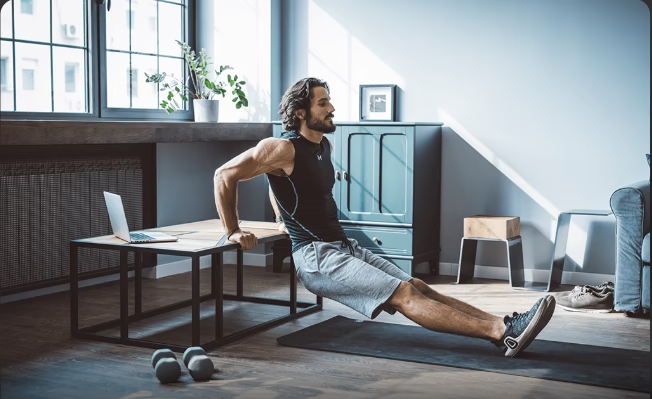
Busy professional doing a quick bodyweight workout in a home office setting during a work break. Free stock photo.
A 2020 survey published by the CDC’s Behavioral Risk Factor Surveillance System found that only 24% of U.S. adults meet both the aerobic and muscle-strengthening guidelines recommended for adults. Office-based professionals report the lowest activity levels of any occupational category, largely due to:
- Commute time replacing what would otherwise be active transit (walking, cycling)
- Decision fatigue by end of workday, reducing willpower for gym travel
- The misconception that effective exercise requires 45–60+ minutes or a gym membership
- Unpredictable meeting schedules making fixed-time commitments unreliable
The solution that the research supports is removing every possible point of friction: no commute, no equipment, no membership, and short time blocks that fit into a workday rather than requiring a separate life event.
2. Is Bodyweight Training Actually Effective? What the Research Shows
Direct answer: Yes. Bodyweight resistance training produces measurable strength, muscle, and cardiovascular improvements comparable to equipment-based training, provided exercises are performed with sufficient intensity and progressive difficulty.
The Mechanism: Why Bodyweight Training Works
Strength training — with or without external weights — works through a principle called progressive overload: applying a training stimulus greater than what the muscle is currently adapted to, which triggers adaptation (strength and size gains).
With bodyweight training, you can manipulate intensity through several variables instead of adding external weight:
- Leverage changes (e.g., decline push-ups are harder than standard push-ups)
- Tempo manipulation (slowing the eccentric/lowering phase increases time under tension)
- Unilateral loading (single-leg squats are significantly more demanding than two-leg squats)
- Reduced rest intervals (increases cardiovascular and metabolic demand)
- Increased range of motion (deeper squats, fuller push-up range)
The Evidence Base
A study published in the Journal of Sports Science & Medicine (Calatayud et al.) found that a structured bodyweight circuit training program produced significant improvements in muscular strength, body composition, and cardiorespiratory fitness in untrained adults over an 8-week period — with no equipment used at any point.
Separately, a meta-analysis in the International Journal of Environmental Research and Public Health examined high-intensity bodyweight interval training and found it produced VO2 max improvements comparable to traditional equipment-based HIIT protocols, while requiring significantly less time per session (under 20 minutes) than steady-state cardio approaches.
Mechanism explained: High-intensity interval-style bodyweight training elevates heart rate into the 80–95% of max HR range during work intervals. This intensity level triggers excess post-exercise oxygen consumption (EPOC) — your body continues burning calories at an elevated rate for hours after the session ends, an effect not seen with low-intensity steady-state exercise.
Bottom line for busy professionals: You do not need a gym, weights, or even 30 minutes to produce meaningful fitness adaptations. You need correct exercise selection, sufficient intensity, and consistency.
3. How to Build a No-Equipment Home Workout Routine: The Complete Framework
Direct answer: An effective no-equipment routine should include three components each session: a brief warm-up (3–5 minutes), a strength/conditioning circuit targeting all major muscle groups (10–15 minutes), and a short cool-down with stretching (2–3 minutes) — performed 3–4 times per week with at least one rest day between sessions targeting the same movement patterns.
The 5 Movement Patterns Every Routine Should Include
Physical therapists and exercise scientists classify functional movement into patterns that, together, train the entire body without requiring isolated machine-based exercises:
| Movement Pattern | Bodyweight Examples | Muscles Trained |
|---|---|---|
| Squat (knee-dominant) | Bodyweight squat, lunge, split squat | Quads, glutes, core |
| Hinge (hip-dominant) | Glute bridge, single-leg deadlift (bodyweight) | Hamstrings, glutes, lower back |
| Push | Push-up, incline push-up, pike push-up | Chest, shoulders, triceps |
| Pull | Towel/door row, isometric scapular squeeze | Back, biceps, rear shoulders |
| Core/Anti-rotation | Plank, side plank, dead bug, bird dog | Deep core stabilizers |
Why pull exercises are the hardest to replicate without equipment: Without external resistance or a fixed anchor point, training the back and biceps through pulling motions is genuinely more difficult bodyweight-only. Using a sturdy table edge for rows, a resistance band looped around a door handle, or simply prioritizing scapular retraction exercises (isometric holds) helps offset this limitation. This is the one area where even minimal equipment (a $10 resistance band) meaningfully closes the gap.
Weekly Structure Template
| Day | Focus | Duration |
|---|---|---|
| Monday | Full-body strength circuit | 15–20 min |
| Tuesday | Rest or light walk | — |
| Wednesday | HIIT-style conditioning circuit | 12–15 min |
| Thursday | Rest or light walk | — |
| Friday | Full-body strength circuit | 15–20 min |
| Saturday | Optional: mobility/yoga or longer walk | 20–30 min |
| Sunday | Rest | — |
4. The 15-Minute Bodyweight Workout for Beginners (Full Routine)
Direct answer: This 15-minute circuit requires zero equipment, targets all major muscle groups, and is designed to be performed 3 times per week by beginners with no prior strength training experience.
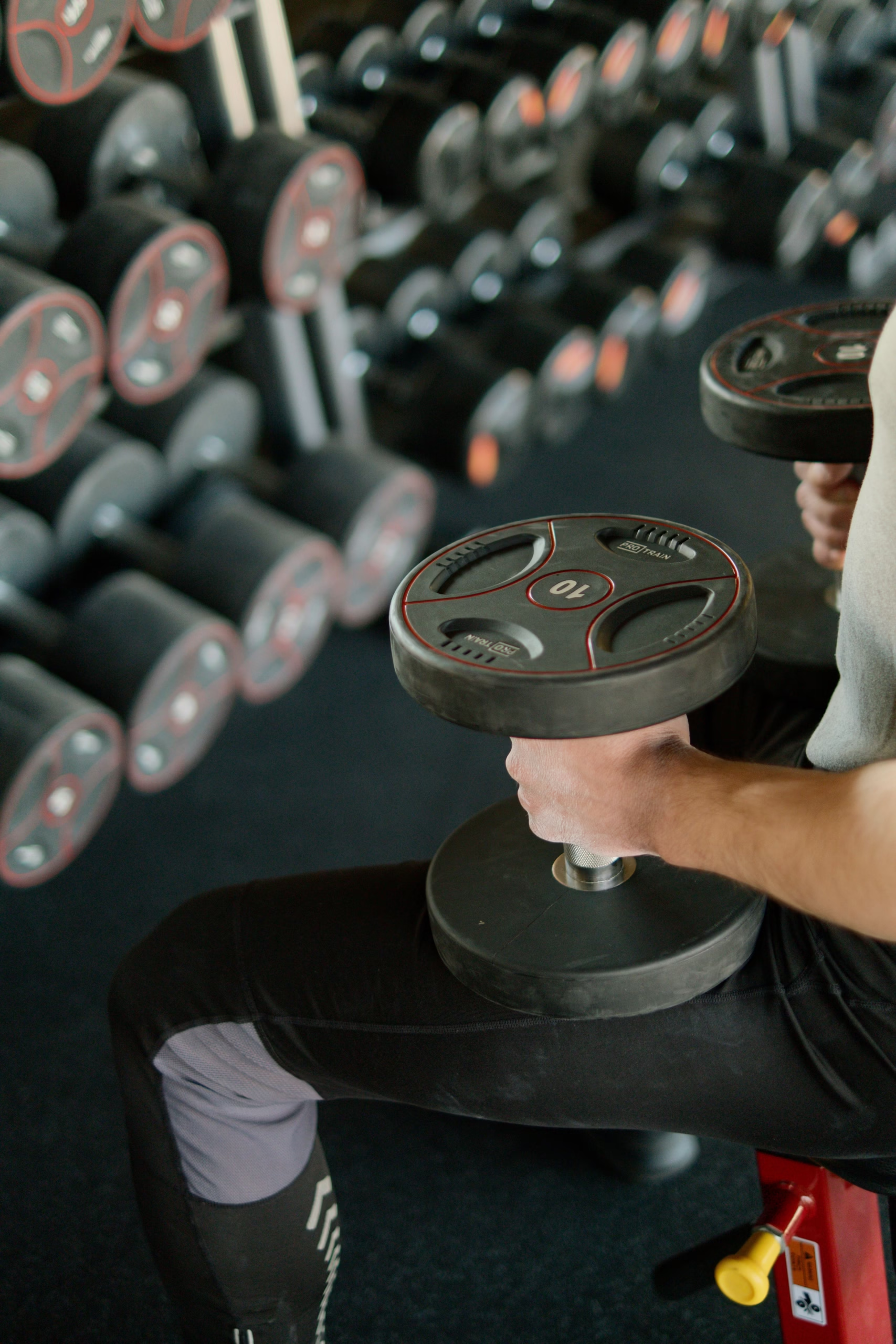
Person performing a push-up with proper form as part of a no-equipment home workout routine. Free stock photo.
Warm-Up (3 minutes)
- 30 seconds marching in place
- 30 seconds arm circles (forward and backward)
- 30 seconds bodyweight squats (slow, controlled)
- 30 seconds hip circles
- 30 seconds gentle torso twists
- 30 seconds high knees (light pace)
Main Circuit — 3 Rounds, 40 Seconds Work / 20 Seconds Rest
- Bodyweight squats — feet shoulder-width, chest up, knees tracking over toes
- Push-ups (modified on knees if needed) — hands slightly wider than shoulders
- Glute bridges — lying on back, drive hips up, squeeze glutes at top
- Plank hold — forearms down, body in straight line, core engaged
- Reverse lunges (alternating) — step back, lower until both knees ~90°
- Standing scapular squeeze (pull substitute) — arms at 90°, pull shoulder blades together and hold
Rest 60 seconds between rounds.
Cool-Down (2–3 minutes)
- Standing quad stretch (30 sec each side)
- Standing hamstring stretch (30 sec each side)
- Chest doorway stretch (30 sec each side)
- Deep diaphragmatic breathing (1 minute)
Total time: approximately 15 minutes. This routine can be done in workout clothes, business casual with shoes off, or even during a long conference call (audio-only) for several of the exercises.
5. How to Progress Your Bodyweight Training Over Time
Direct answer: Progress bodyweight training by manipulating difficulty variables in this order: increase repetitions first, then reduce rest periods, then add tempo control, then move to more mechanically demanding exercise variations (e.g., standard push-up → diamond push-up → archer push-up).
The Progression Ladder
Stage 1 (Weeks 1–4): Master the Pattern
Focus entirely on form. Perform each exercise at a comfortable repetition range (8–12 reps) with full range of motion. Video yourself if possible — form errors are the leading cause of bodyweight training injuries.
Stage 2 (Weeks 5–8): Increase Volume
Once form is consistent, increase from 3 rounds to 4 rounds, or increase work intervals from 40 seconds to 50 seconds.
Stage 3 (Weeks 9–12): Manipulate Tempo
Slow the eccentric (lowering) phase of each exercise to a 3–4 second count. This dramatically increases time under tension without requiring any new exercises.
Stage 4 (Month 4+): Progress Exercise Difficulty
| Base Exercise | Progression 1 | Progression 2 (Advanced) |
|---|---|---|
| Knee push-up | Standard push-up | Decline push-up (feet elevated) |
| Bodyweight squat | Bulgarian split squat | Pistol squat (single-leg) |
| Glute bridge | Single-leg glute bridge | Single-leg hip thrust (elevated) |
| Plank | Plank with shoulder taps | Plank with leg lifts |
| Reverse lunge | Lunge with knee drive | Jumping lunge (plyometric) |
A 2019 study in the Journal of Strength and Conditioning Research confirmed that manipulating leverage and stability demands in bodyweight exercises produces measurable, graded increases in muscle activation — meaning this progression model has a genuine physiological basis, not just a perceived difficulty increase.
6. How to Fit Exercise Into an Unpredictable Work Schedule
Direct answer: The most evidence-supported strategy for unpredictable schedules is “habit stacking” — anchoring your workout to an existing, non-negotiable daily event (e.g., immediately after your first coffee, or immediately after your last work call ends) rather than to a fixed clock time.
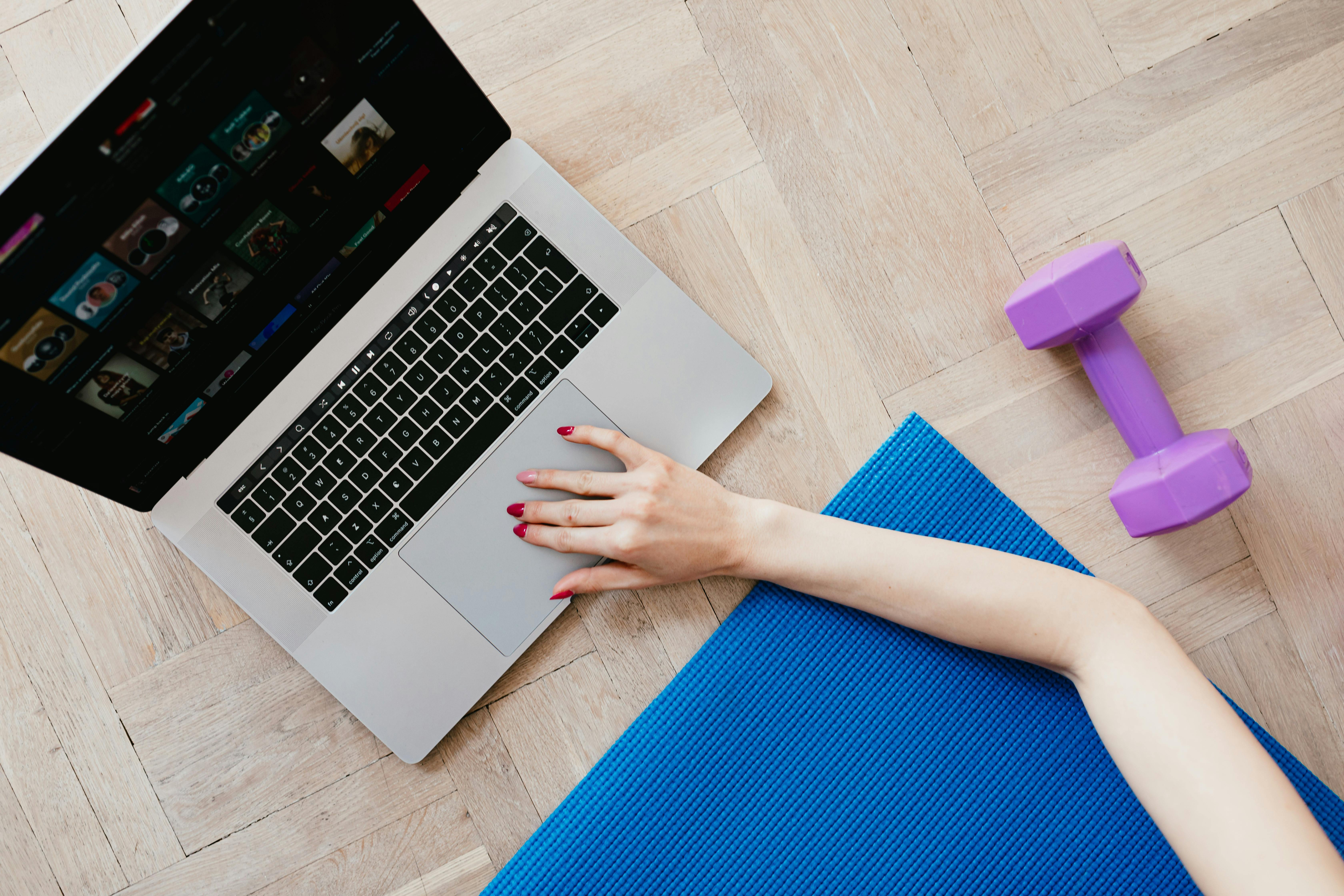
Person setting an interval timer on their phone before starting a quick home workout session. Free stock photo.
Why Fixed Clock Times Fail for Professionals With Variable Schedules
Behavioral research on habit formation (Dr. Phillippa Lally, University College London) shows that habits anchored to stable environmental cues form faster and persist longer than habits anchored to arbitrary times. If your meeting schedule shifts daily, “6 PM workout” is a fragile commitment. “Workout immediately after my last meeting ends” is resilient to schedule changes because the trigger moves with you.
4 Practical Strategies for Inconsistent Schedules
1. The “Meeting Block” Method
Identify your one truly predictable daily anchor (first coffee, lunch break, end of workday) and commit the workout to that specific trigger — not a clock time.
2. The “Minimum Viable Workout” Rule
On days where 15 minutes feels impossible, commit to a 5-minute minimum version (e.g., just the main circuit, one round, no warm-up/cool-down). Research on habit consistency shows that maintaining the habit’s existence matters more than its duration during high-stress periods — a 5-minute session preserves the habit chain far better than skipping entirely.
3. Calendar Blocking as a Real Meeting
Treat your workout block in your calendar exactly as you would a client meeting — same visibility, same protection from being overwritten. Studies on time management consistently show that scheduled commitments are protected far more reliably than vague intentions.
4. The “Two-Day Rule”
If you miss a planned session, the rule is simple: never miss two in a row. This single behavioral guardrail, used in many structured fitness coaching programs, significantly reduces the likelihood of total habit abandonment after an initial lapse.
7. What Are the Most Common Injuries From Home Workouts — and How to Prevent Them?
Direct answer: The most common injuries in unsupervised home bodyweight training are lower back strain (from poor hip hinge mechanics), wrist pain (from push-up hand positioning), and knee discomfort (from improper squat tracking) — all of which are preventable through proper form, adequate warm-up, and appropriate progression pacing.
Common Form Errors and Corrections
Lower Back Strain
- Cause: Excessive lumbar arching during glute bridges or rounding during planks
- Correction: Engage the core to maintain a neutral spine; imagine “tucking” the pelvis slightly during bridges and planks
Wrist Pain During Push-Ups
- Cause: Hands positioned too far forward, placing excess weight on wrist extension
- Correction: Position hands directly under or slightly wider than shoulders; consider performing push-ups on fists or using push-up handles if wrist mobility is limited
Knee Discomfort During Squats
- Cause: Knees collapsing inward (valgus collapse) or excessive forward travel past toes
- Correction: Actively push knees outward in line with toes; slow the descent to maintain control
When to See a Physical Therapist or Physician
According to clinical guidance from the American Physical Therapy Association, you should consult a professional before continuing a home exercise program if you experience:
- Sharp, localized pain that doesn’t improve with rest
- Joint swelling following exercise
- Pain that worsens progressively across sessions rather than improving
- Numbness or tingling during or after exercises
- Pre-existing cardiovascular conditions, recent surgery, or pregnancy (these warrant a pre-exercise medical clearance regardless of symptoms)
8. Does Desk-Based Micro-Exercise Actually Help?
Direct answer: Yes. Research increasingly supports “exercise snacking” — brief bouts of movement (1–5 minutes) distributed throughout the workday — as a legitimate strategy with measurable metabolic and musculoskeletal benefits, independent of and additive to a structured daily workout.
The Research on Exercise Snacking
A study published in the Journal of Physiology (Jenkins et al.) found that brief, vigorous “exercise snacks” — as short as 20 seconds of stair climbing performed several times throughout the day — produced measurable improvements in cardiorespiratory fitness over 6 weeks in sedentary adults.
Separately, research published in Diabetologia found that interrupting prolonged sitting with brief 2–3 minute walking or resistance breaks every 30 minutes significantly improved post-meal blood glucose and insulin response compared to uninterrupted sitting — even when total daily exercise time was held constant.
5 Desk-Compatible Micro-Exercises
- Seated marching (1 minute) — engages hip flexors and core while seated
- Standing calf raises (30–60 seconds) — improves circulation during long sitting periods
- Doorway chest stretch (30 seconds) — counters forward shoulder rounding from typing
- Wall sit (30–45 seconds) — quick isometric lower-body activation between calls
- Seated spinal twist (30 seconds each side) — relieves lower back stiffness from sitting
Practical implementation: Set a recurring calendar reminder or phone alarm every 60–90 minutes to perform one micro-exercise. This is not a replacement for structured strength training but is a meaningful complement, particularly for cardiometabolic health.
9. People Also Ask (FAQs)
Can you really get fit with no equipment at all?
Yes. Multiple peer-reviewed studies confirm that structured bodyweight training programs produce significant improvements in strength, muscle endurance, body composition, and cardiovascular fitness in previously sedentary adults. Equipment can add variety and eventually become necessary for very advanced strength goals, but for the large majority of fitness and health outcomes relevant to busy professionals, bodyweight training is sufficient.
How many days a week should a beginner do bodyweight workouts?
Most exercise science guidance, including recommendations consistent with the CDC Physical Activity Guidelines, supports 3–4 non-consecutive days per week for strength-focused bodyweight training, allowing 48 hours of recovery between sessions targeting the same muscle groups. Beginners should prioritize consistency at 3 days per week before increasing frequency.
Is a 15-minute workout actually long enough to see results?
For previously sedentary or moderately active individuals, yes — provided the workout includes adequate intensity (such as the circuit format described in this guide) and is performed consistently. Research on high-intensity interval training confirms that shorter, higher-intensity sessions can produce cardiovascular and metabolic benefits comparable to longer, lower-intensity sessions. Results scale with consistency over weeks and months, not single-session duration alone.
What is the best time of day to work out for busy professionals?
There is no universally “best” time backed by strong individual-level evidence — the best time is the one you can sustain consistently. That said, behavioral research suggests anchoring workouts to a stable daily cue (rather than an exact clock time) improves long-term adherence for people with unpredictable schedules, which is often more achievable early in the day before work demands accumulate.
How do I know if I’m doing bodyweight exercises with correct form?
Recording yourself on video and comparing your form to demonstrations from credentialed sources (physical therapists, certified strength coaches) is one of the most accessible ways to self-check form. Common red flags include pain during movement (versus normal muscular fatigue), inability to complete the full range of motion, or significant asymmetry between left and right sides. If uncertain, a single consultation with a physical therapist or certified trainer can correct form issues early.
Can bodyweight training build muscle, or only “tone” the body?
Bodyweight training can build genuine muscle mass (hypertrophy), not merely “tone” — a term without a distinct physiological meaning. Muscle growth requires progressive overload, which bodyweight training achieves through leverage changes, tempo manipulation, and increasingly difficult exercise variations, as outlined in the progression framework in this guide. Strength gains from bodyweight training are well documented in peer-reviewed exercise science literature.
10. Content Cluster: Related Articles
This is the pillar page of our Home-Based Fitness content cluster. Explore our spoke articles:
- How to Improve Sleep Quality: The Ultimate Evidence-Based Guide (2026)
- How to Manage Stress and Protect Your Mental Health: A Complete Evidence-Based Guide (2026)
- Weight Loss and Sustainable Fitness in 2026: GLP-1 Medications, Ozempic Alternatives, and Long-Term Success
- How to Live Longer and Stronger: The Complete Guide to Preventive Health, Strength Training, Cognitive Fitness, and Longevity (2026)
Key Takeaways
- Equipment is not the real barrier to fitness for busy professionals — time perception, decision fatigue, and habit design are the actual obstacles, and all three are solvable.
- Bodyweight training is genuinely effective, with peer-reviewed research confirming comparable strength and cardiovascular benefits to equipment-based training when intensity and progression are applied correctly.
- A 15-minute, 3-day-per-week routine is sufficient to produce measurable results for beginners — start with the framework provided and progress using the structured ladder in Section 5.
- Habit-stack your workout to a stable daily cue, not a fixed clock time, if your schedule is unpredictable — this is the single most effective adherence strategy supported by behavioral research.
- Exercise snacking throughout the workday is a legitimate, evidence-backed complement to structured training, not just a consolation prize for missed workouts.
- Form matters more than intensity when starting out — review the injury prevention guidance in Section 7 before increasing difficulty.
Sources: CDC Physical Activity Guidelines, American Physical Therapy Association, Journal of Sports Science & Medicine, Journal of Strength and Conditioning Research, Journal of Physiology, Diabetologia, International Journal of Environmental Research and Public Health
This article is for informational and educational purposes only and does not constitute medical advice. Please consult a qualified healthcare professional before beginning any new exercise program.