
The Silicon Shield: How Taiwan’s Chip Dominance Shapes Global Security
In the modern era, the most strategic resource on the planet isn’t found in oil fields — it’s found in the microscopic circuits of semiconductors. Often called “the new oil,” these tiny chips power everything from the smartphone in your pocket to advanced fighter jets and the AI data centers reshaping the global economy. At the center of this high-stakes industry sits a single island: Taiwan, and the strategic concept known as the Silicon Shield.

Table of Contents
- The Rise of TSMC: The World’s Most Important Company
- What Is the “Silicon Shield”?
- The Chip War: U.S. vs. China
- The Staggering Complexity of Chip Making
- Challenges in the “Silicon Desert”
- The Future: AI and Beyond
- FAQ
The Rise of TSMC: The World’s Most Important Company {#tsmc-rise}
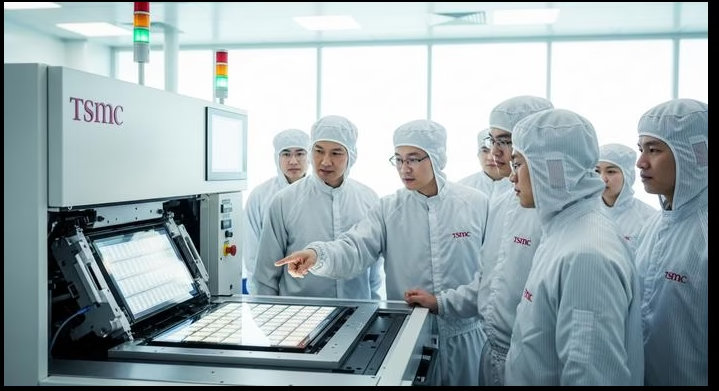
Taiwan’s dominance in this industry is largely due to one company: TSMC (Taiwan Semiconductor Manufacturing Company), which produces an estimated 92% of the world’s most advanced microchips.
Founded in 1987 by Morris Chang, TSMC pioneered the “pure-play foundry” model — a business strategy where the company focuses exclusively on manufacturing chips designed by others, such as Apple, Nvidia, and Qualcomm, rather than designing its own products. This hyper-specialization let TSMC build a scale and technological lead that has proven extremely difficult for competitors to replicate.
Today, TSMC ranks among the ten most valuable companies in the world, and its production capacity is considered so critical that any significant disruption could ripple through the entire global digital economy.
What Is the “Silicon Shield”? {#silicon-shield-defined}
The term Silicon Shield describes the idea that Taiwan’s indispensable role in the global semiconductor supply chain acts as a deterrent against military conflict. Because the world — including China — depends so heavily on Taiwanese-made chips, any disruption to production would likely trigger a global financial shock, with economic loss estimates ranging anywhere from roughly $600 billion to $10 trillion, depending on the scenario modeled and its duration.
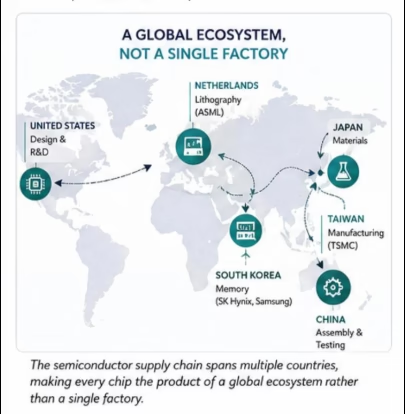
- Economic defense by design: Taiwan deliberately built out this industry starting in the 1970s, partly as a strategy to create durable economic leverage and international interdependence.
- Global interdependence, despite reshoring efforts: Even as the U.S., China, and other major powers race to build domestic foundries, they remain reliant on Taiwan’s expertise for producing the most advanced chip nodes available today.
The Chip War: U.S. vs. China {#chip-war}
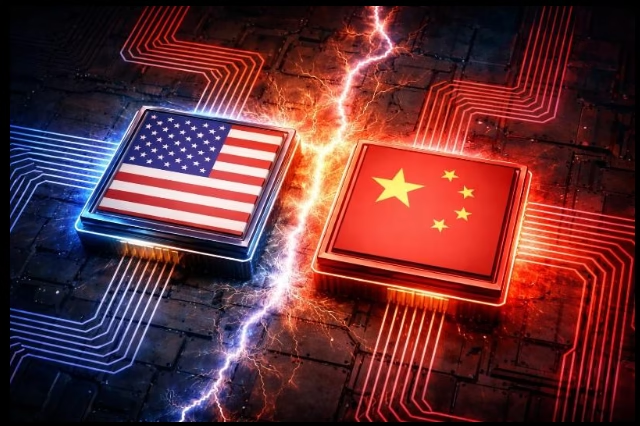
The strategic value of semiconductors has fueled what’s now widely referred to as the “Chip War.” The United States has pursued aggressive measures to secure its own supply chain through the CHIPS and Science Act, a roughly $52 billion investment aimed at reshoring advanced chip manufacturing onto American soil.
Meanwhile, China, which regards Taiwan as a breakaway province, has poured significant investment into its own domestic champion, SMIC, in pursuit of technological self-sufficiency. China’s efforts currently face real constraints, including U.S. export restrictions on critical manufacturing equipment — most notably ASML’s EUV lithography machines, which are essential for producing the most advanced chips available today.
The Staggering Complexity of Chip Making {#chip-complexity}
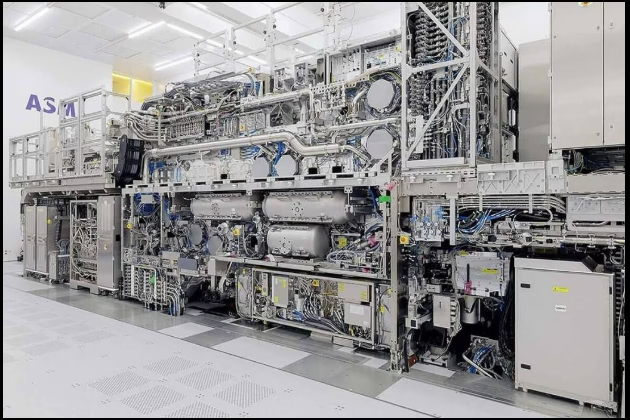
Manufacturing a modern semiconductor is arguably one of the most technically demanding processes ever undertaken by humans. It begins with ordinary sand, which is purified into silicon wafers reaching 99.9999% purity.
- Precision: Features on the most advanced chips are measured in nanometers — thousands of times smaller than a human hair, and smaller than most viruses.
- Cleanliness: Semiconductor fabrication plants (“fabs”) maintain cleanroom conditions roughly 1,000 times cleaner than a surgical operating room, since a single speck of dust can ruin an entire multimillion-dollar batch of wafers.
- A genuine technology monopoly: Only one company in the world — ASML, based in the Netherlands — currently produces the Extreme Ultraviolet (EUV) lithography machines required to print these minuscule circuit designs.
Challenges in the “Silicon Desert” {#silicon-desert}
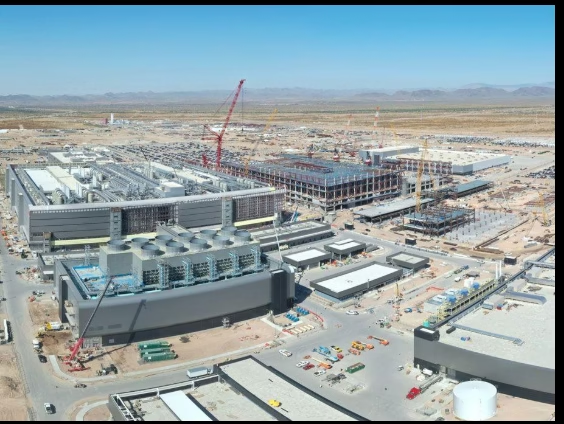
To reduce the risk of over-concentration in Taiwan, TSMC has committed roughly $65 billion to a mega-site in Arizona. The project — sometimes nicknamed the “Arizona challenge” in industry commentary — has faced delays, high construction costs, and a shortage of specialized skilled labor.
Industry executives have publicly noted that building and operating a fab in the U.S. is meaningfully more expensive and time-consuming than in Taiwan, where a dense, mature ecosystem of specialized suppliers already exists to support rapid, efficient fab construction and operation.
The Future: AI and Beyond {#ai-future}

The AI boom has pushed the global semiconductor supply chain to its limits. Chips like Nvidia’s H100 — which can cost upwards of $25,000 per unit — are essential for training large language models and other advanced AI systems. As global demand for AI infrastructure continues to grow, dependence on the small handful of companies capable of producing these chips is likely to deepen rather than ease.
Frequently Asked Questions {#faq}
What does “Silicon Shield” mean? Silicon Shield refers to the theory that Taiwan’s central, difficult-to-replace role in global chip manufacturing discourages military conflict, since a disruption to Taiwanese chip production would cause severe global economic damage that would affect China and the rest of the world alike.
Why is TSMC so important? TSMC manufactures an estimated 92% of the world’s most advanced microchips and produces chips designed by major companies like Apple and Nvidia, making it a critical single point in the global technology supply chain.
What is the CHIPS Act? The CHIPS and Science Act is a U.S. law providing roughly $52 billion in incentives to expand domestic semiconductor manufacturing and research, aimed at reducing American reliance on chip production concentrated in Taiwan and elsewhere in Asia.
Why can’t other countries easily replicate Taiwan’s chip industry? Advanced chip manufacturing requires an extremely dense ecosystem of specialized suppliers, highly skilled labor, and decades of accumulated process expertise — all of which Taiwan built over 40-plus years and which is difficult and slow to reproduce elsewhere, as seen in the delays facing TSMC’s Arizona expansion.
What is ASML and why does it matter so much? ASML, based in the Netherlands, is currently the only company in the world producing Extreme Ultraviolet (EUV) lithography machines, which are required to manufacture the most advanced semiconductor chips — making it a critical chokepoint in the global chip supply chain alongside TSMC.
External Resources for Further Reading
- TSMC — Official Website
- Intel Foundry Services
- ASML — Company Overview
- U.S. Department of Commerce — The CHIPS Act
Related Articles
- Best AI Coding Tools 2026
- Best AI Video Creation Tools 2026
- Top AI Tools in 2026: The Ultimate Guide for Productivity, Content Creation, Coding, and Business
- Investing for Growth with $100
- How to Make Money with AII
- Best AI Image Generation Tools 2026
Note: This article discusses publicly reported geopolitical and industry dynamics. Figures such as economic loss estimates and project costs are drawn from public reporting and industry analysis, and may vary depending on the source and methodology used; verify current figures independently for time-sensitive decisions.