
What Happens After Death? The Science, Near-Death Experiences & Afterlife Beliefs Explained
The question of what happens after death is perhaps the most profound mystery of human experience. Roughly 150,000 people die every day, yet what actually happens — biologically, neurologically, and beyond — remains a blend of hard scientific data, deeply held religious doctrine, and extraordinary personal testimony. Increasingly, researchers describe death not as a single instant, an “off switch,” but as a complex, multi-stage process.
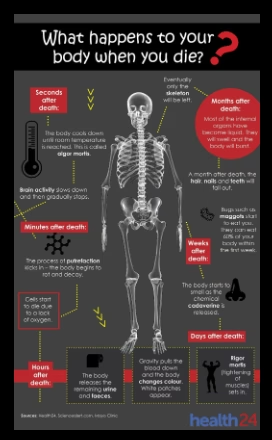
Table of Contents
- The Biological Perspective: What Happens to the Body
- The Dying Brain: A Final Surge of Activity
- Near-Death Experiences and Reported Perceptions
- How Major Religions Describe the Afterlife
- Quantum Consciousness: A Contested Theory
- FAQ
The Biological Perspective: What Happens to the Body {#biological-perspective}
From a purely physical standpoint, death triggers a well-documented biological sequence.
- Algor mortis: Once the heart stops, the body begins cooling at roughly 0.8-1.5°F per hour until it reaches the temperature of its surroundings.
- Rigor mortis: Within two to six hours, muscle cells exhaust their energy supply, causing protein filaments to lock in place and stiffen the body temporarily.
- Autolysis: As cells are deprived of oxygen, they release enzymes that begin digesting tissue from the inside out.
- Decomposition: Bacteria in the gastrointestinal tract begin breaking down tissue, producing gases such as methane and hydrogen sulfide that cause bloating. Over time, decomposers and natural chemical cycles return the body’s atoms to the surrounding ecosystem — quite literally feeding new life.
The Dying Brain: A Final Surge of Activity {#dying-brain}
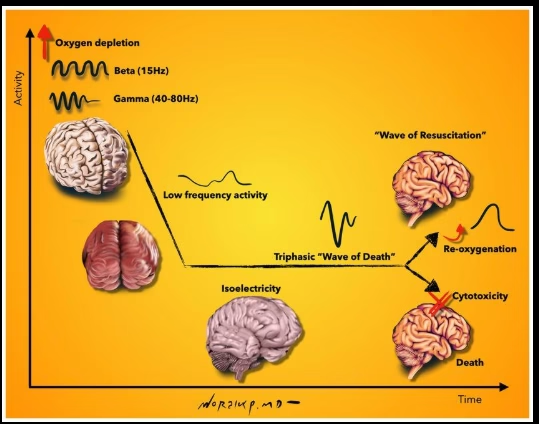
Recent neuroscience research suggests the brain doesn’t simply “go dark” the moment the heart stops. In a widely discussed 2022 case study, researchers monitoring an 87-year-old patient recorded a surge of gamma wave activity — the fastest brain oscillations, typically associated with memory recall and meditative states — for roughly 30 seconds after the patient’s heart stopped. Some researchers have proposed this could reflect a kind of final memory-recall process, though it’s worth noting this is based on a single documented case and remains an active, unsettled area of research rather than a confirmed mechanism.
A few competing explanations exist for the vivid experiences some people report during this window:
- The DMT hypothesis: Some researchers have hypothesized that a surge of naturally occurring DMT (dimethyltryptamine), a potent psychedelic compound, could play a role in generating these experiences — though direct evidence in dying human brains remains limited.
- The oxygen-deprivation hypothesis: Neuroscientist Susan Blackmore and others have argued that common visual experiences like a “tunnel of light” may instead result from random neural firing in the visual cortex as it’s starved of oxygen — a more conservative, mechanistic explanation that doesn’t require any exotic chemical trigger.
Near-Death Experiences and Reported Perceptions {#near-death-experiences}
Thousands of people who have survived clinical death report strikingly similar experiences: a sense of peace, a feeling of separation from the body, and a “life review.” Researcher John Burke, who studied roughly 1,500 documented near-death experience (NDE) cases, reported that a high percentage of specific, checkable details recalled by patients — such as accurately describing medical equipment or conversations that occurred while they were clinically flatlined — matched what actually happened in the room.
Two frequently cited individual cases include:
- Pam Reynolds, who reportedly described the specific shape of a surgical bone-cutting tool and recalled details of conversations during a procedure in which her brain activity and heartbeat were deliberately stopped by machines for part of the surgery.
- Charlotte Holmes, who described watching her own resuscitation from above the hospital bed, along with sensory details like a specific pleasant scent and a felt presence of deceased family members.
Important context: These cases are widely discussed in NDE research literature, but they remain contested within mainstream neuroscience. Critics point out that verifying exactly what a patient could or couldn’t have perceived through ordinary senses (residual hearing, subtle cues, prior knowledge) is extremely difficult after the fact, and memory itself can be reconstructed or embellished over time. Both the researchers who take these accounts seriously and the scientists who remain skeptical agree that better-controlled prospective studies are needed before firm conclusions can be drawn.
How Major Religions Describe the Afterlife {#religious-perspectives}
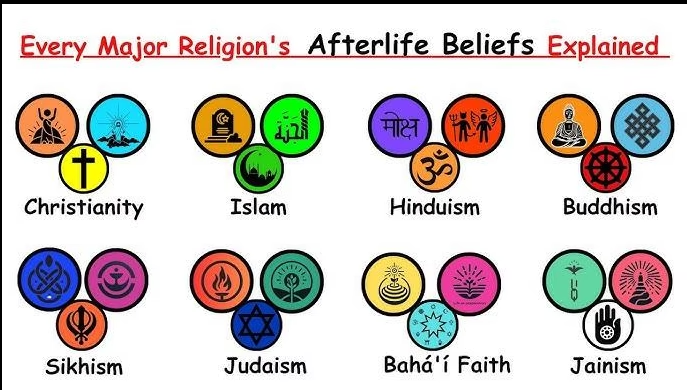
For millennia, world religions have offered detailed frameworks for what happens after death — many of which echo elements found in modern NDE accounts.
- Hinduism: The Garuda Purana describes a 13-day journey in which the soul (Atma) detaches from the body and is judged by Yamraj based on karma, ultimately continuing through the cycle of rebirth (Samsara) unless liberation (Moksha) is achieved.
- Islam: Islamic teaching describes Barzakh, a barrier state in which the soul remains in the grave, questioned by the angels Munkar and Nakir, awaiting the final Day of Judgment.
- Christianity: Many Christian traditions teach that believers are immediately “at home with the Lord” upon death, while awaiting a future bodily resurrection at the end of time.
- Buddhism: Buddhist teaching describes the Bardo, a transitional state lasting up to 49 days in which consciousness experiences visions understood to be reflections of one’s own mind, prior to rebirth.
Quantum Consciousness: A Contested Theory {#quantum-consciousness}
Some theoretical physicists have proposed that consciousness might not be fully explained by classical brain activity alone. The Orchestrated Objective Reduction (Orch OR) theory, proposed by physicist Sir Roger Penrose and anesthesiologist Stuart Hameroff, suggests consciousness may arise from quantum-level processes occurring in microtubules within neurons. Under this theory, some proponents speculate that quantum information could theoretically persist beyond the physical body’s function — though this remains a minority, unproven position within physics and neuroscience, with many researchers arguing there’s no verified mechanism by which quantum effects at this scale could survive or meaningfully influence brain function.
Separately, some clinicians have documented cases of terminal lucidity — instances where patients with severe dementia or Alzheimer’s disease unexpectedly regain clear memory and personality in the hours or days before death. This phenomenon is genuinely observed and reported in medical literature, though its underlying mechanism remains unclear and is an active area of clinical interest rather than a settled explanation.
Frequently Asked Questions {#faq}
What is the first thing that happens to the body after death? The body begins cooling immediately (algor mortis), followed by rigor mortis (muscle stiffening) within two to six hours, and later autolysis as oxygen-deprived cells begin breaking down.
Is there scientific evidence for near-death experiences? There is documented research on NDEs, including cases where patients reported accurate details of events during clinical death. However, this remains a scientifically contested area — proponents point to consistent patterns and specific verified details, while skeptics point to the difficulty of ruling out residual sensory perception or memory reconstruction.
What is terminal lucidity? Terminal lucidity refers to documented cases where patients with severe cognitive decline, including advanced Alzheimer’s disease, temporarily regain clarity, memory, and personality shortly before death. It is a genuinely observed clinical phenomenon, though the biological mechanism behind it isn’t yet well understood.
Do all religions believe in an afterlife? Most major world religions describe some form of continuation after death, though the specifics vary widely — from cycles of rebirth in Hinduism and Buddhism to a final resurrection and judgment in Christianity and Islam.
What is the Orch OR theory of consciousness? It’s a theory proposed by Roger Penrose and Stuart Hameroff suggesting consciousness arises from quantum-level processes in brain cell structures called microtubules. It remains a minority, unproven theory within physics and neuroscience rather than an accepted explanation of consciousness.
External Resources for Further Reading
- National Institute on Aging — What Happens When We Die
- Encyclopaedia Britannica — Afterlife
- Frontiers in Aging Neuroscience — Surge of Neurophysiological Coupling in the Dying Human Brain
- American Psychological Association — Near-Death Experiences Research Overview
Suggested Internal Links
- Top 10 Highest-Rated Smart Home Lighting Products on Amazon (2026)
- 10 Best Massagers 2026: Leg, Back, Foot & Massage Guns
- Top 10 Best-Selling Smartphones 2026: Full Buying Guide & Comparison
- Top 10 Best-Selling Health Supplements on Amazon
- Best Air Fryers & Healthy Cooking Gadgets on Amazon (2026 Buyer’s Guide)
- Kitchen Tools Every Home Needs: 5 Must-Have Essentials for Faster, Easier Cooking
Note: This article discusses biological, scientific, religious, and philosophical perspectives on death for general educational purposes. Claims involving near-death experiences and quantum consciousness theories remain actively debated within the scientific community and are presented here as reported research and perspectives, not settled fact. If you are grieving, facing a serious illness, or processing thoughts about death that feel distressing, consider speaking with a counselor, chaplain, or healthcare provider trained in this area.