
Blood Types Explained: Genetics, Health Risks, Rare Blood Types & AI Discoveries
Kumar G is the founder of Future Smart Living, sharing expert-backed content on health, wellness, technology, personal finance, and smart living. His goal is to provide practical, trustworthy guides that help readers live healthier, smarter, and more informed lives.
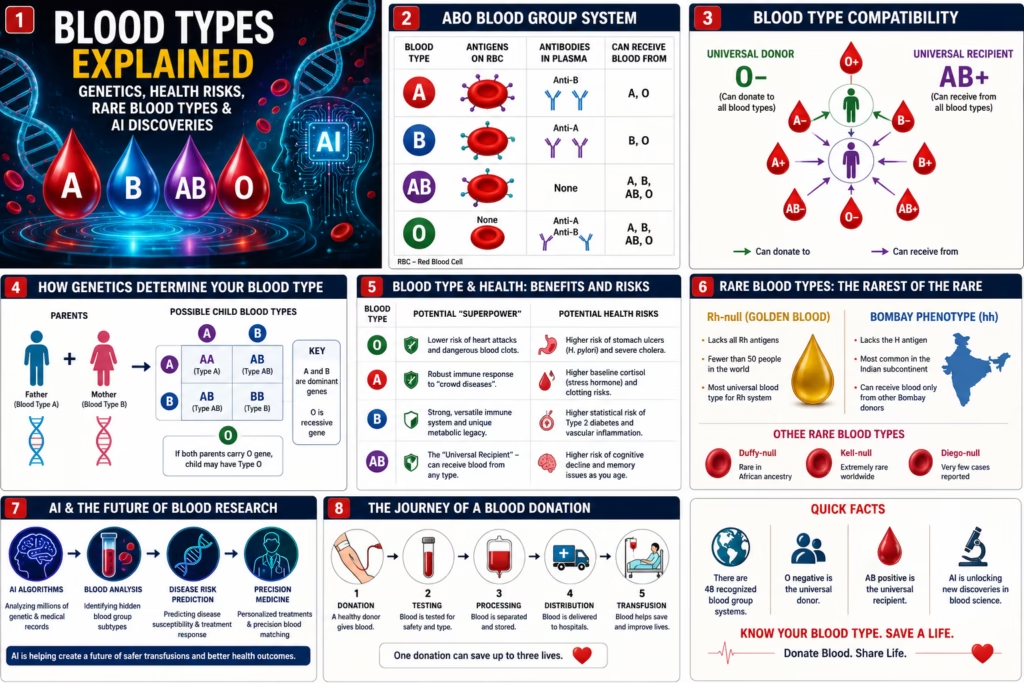
Have you ever wondered why some people can donate blood to almost anyone while others can only receive blood from a limited group? Your blood type is much more than a letter on a medical chart. It is a genetic signature inherited from your parents that influences blood transfusions, disease susceptibility, pregnancy, and even future personalized medicine.
Recent advances in artificial intelligence (AI), genomics, and precision medicine have revealed fascinating insights into how blood types evolved and how they may affect human health.
Whether you’re curious about your own blood type or want to understand the science behind ABO blood groups, Rh factors, rare blood types, and AI discoveries, this comprehensive guide explains everything you need to know.
Table of Contents
- What Are Blood Types?
- The ABO Blood Group System
- Understanding the Rh Factor
- How Genetics Determine Your Blood Type
- Blood Type Compatibility Chart
- How Blood Types Affect Your Health
- The World’s Rarest Blood Types
- AI and the Future of Blood Type Research
- Common Myths About Blood Types
- Frequently Asked Questions
What Are Blood Types?
Blood types classify blood based on specific proteins and sugars called antigens found on the surface of red blood cells.
Your immune system recognizes these antigens as either “self” or “foreign.” Receiving incompatible blood can trigger a dangerous immune reaction.
The two major blood classification systems are:
- ABO Blood Group
- Rh (Rhesus) Factor
Together they create the eight common blood types:
- A+
- A-
- B+
- B-
- AB+
- AB-
- O+
- O-
Understanding the ABO Blood Group System
The ABO blood group system was discovered in 1901 by Karl Landsteiner, a breakthrough that revolutionized blood transfusions.
Each blood type has unique antigens.
| Blood Type | Antigen | Antibodies |
|---|---|---|
| A | A | Anti-B |
| B | B | Anti-A |
| AB | A & B | None |
| O | None | Anti-A & Anti-B |
Because Type O lacks A and B antigens, O Negative is widely known as the Universal Donor for emergency transfusions.
Meanwhile,
AB Positive individuals are considered the Universal Recipient because they can receive blood from every ABO type.
Understanding the Rh Factor
Besides the ABO system, blood is classified as either:
- Rh Positive
- Rh Negative
Rh-positive blood contains the D antigen, while Rh-negative blood does not.
Approximately:
- 85% of people are Rh Positive.
- 15% are Rh Negative.
Rh compatibility becomes especially important during pregnancy.
If an Rh-negative mother carries an Rh-positive baby, medical monitoring is essential to prevent Rh incompatibility complications.
How Genetics Determine Your Blood Type
Blood type is inherited from both parents.
The ABO gene on chromosome 9 determines whether you inherit:
- A
- B
- O
A and B are dominant genes.
O is recessive.
Example inheritance:
| Parent 1 | Parent 2 | Possible Child Blood Types |
|---|---|---|
| A | O | A or O |
| B | O | B or O |
| A | B | A, B, AB or O |
| O | O | O only |
Scientists believe the ABO gene has existed for nearly 20 million years, making it one of humanity’s oldest surviving genetic systems.
How Blood Types Affect Your Health
Although blood type does not determine your destiny, research suggests certain blood groups may influence the likelihood of developing specific diseases.
Blood Type O
Potential Benefits
- Lower risk of blood clots
- Lower risk of coronary heart disease
- Universal donor (O Negative)
Possible Risks
- Higher risk of stomach ulcers caused by Helicobacter pylori
- Increased susceptibility to severe cholera
Blood Type A
Potential Benefits
- Strong immune response against several infectious diseases
Possible Risks
- Higher risk of cardiovascular disease
- Increased blood clotting tendency
- Higher cortisol levels in some studies
Blood Type B
Potential Benefits
- Diverse immune response
- Adaptability to changing environments
Possible Risks
- Increased risk of Type 2 diabetes in some populations
- Higher vascular inflammation risk
Blood Type AB
Potential Benefits
- Universal plasma recipient
- Can receive blood from every ABO group (if Rh compatible)
Possible Risks
- Higher risk of stroke
- Increased likelihood of cognitive decline reported in some observational studies
Important: Blood type is only one of many factors influencing health. Lifestyle, diet, exercise, smoking, sleep, and genetics play a much larger role in determining disease risk.
Rare Blood Types You Should Know
Rh-null (Golden Blood)
Known as Golden Blood, Rh-null is among the rarest blood types on Earth.
Fewer than 50 documented individuals have been identified worldwide.
Because it lacks every Rh antigen, it is extraordinarily valuable for rare transfusions.
However, finding compatible blood for Rh-null individuals is extremely difficult.
Bombay Blood Group (hh)
The Bombay Phenotype is exceptionally rare but occurs more frequently in parts of India.
Unlike Type O blood, Bombay blood lacks the essential H antigen.
As a result, these individuals can receive blood only from other Bombay donors.
AI Is Transforming Blood Type Research
Artificial intelligence is revolutionizing blood science by analyzing millions of genetic records simultaneously.
Researchers are using AI to:
- Discover hidden blood group subtypes
- Improve transfusion compatibility
- Predict disease risk
- Personalize treatments
- Improve blood donor matching
- Accelerate precision medicine
Scientists are also developing enzymes capable of converting Type A blood into universal donor blood, which could significantly reduce blood shortages in the future.
Common Myths About Blood Types
Myth: Your blood type determines your personality.
Fact: Scientific research has found no reliable evidence supporting this claim.
Myth: Blood Type O is the original human blood type.
Fact: Genetic evidence suggests Type A may be the ancestral blood group, while Type O evolved later through mutation.
Myth: Blood type diets work for everyone.
Fact: Large reviews have found little scientific evidence supporting diets based solely on blood type. Overall eating patterns and lifestyle remain much more important for health.
Tips for Maintaining Healthy Blood
- Eat iron-rich foods.
- Get enough Vitamin B12 and folate.
- Donate blood regularly if eligible.
- Stay hydrated.
- Exercise consistently.
- Know your blood type before emergencies.
- Schedule regular health checkups.
Frequently Asked Questions
Which blood type is the rarest?
Rh-null (Golden Blood) is considered one of the rarest blood types in the world.
Which blood type is the universal donor?
O Negative blood can usually be given during emergencies when an immediate transfusion is needed.
Which blood type is the universal recipient?
AB Positive can receive red blood cells from all ABO and Rh blood groups.
Can blood type predict disease?
Blood type may slightly influence disease risk, but it cannot predict whether someone will develop a disease. Lifestyle and genetics remain much more important.
Can AI identify new blood groups?
AI is helping researchers discover new blood group variants and improve precision transfusion medicine, but it does not replace laboratory blood typing.
Final Thoughts
Your blood type is more than a compatibility label—it reflects millions of years of human evolution and provides valuable information for modern medicine. While scientists continue exploring links between blood groups, genetics, and disease, maintaining a healthy lifestyle remains the most effective way to protect your overall health.
As AI advances, blood typing is moving beyond simple letters toward precision medicine, where treatments and transfusions may one day be tailored to each person’s unique biological profile.
External Resources (High Authority)
- American Red Cross – Blood Types: https://www.redcrossblood.org/donate-blood/blood-types.html
- National Institutes of Health (NIH) – ABO Blood Group System: https://www.ncbi.nlm.nih.gov/books/NBK2267/
- International Society of Blood Transfusion (ISBT): https://www.isbtweb.org/
- CDC – Blood Safety: https://www.cdc.gov/bloodsafety/
- NHS – Blood Groups: https://www.nhs.uk/conditions/blood-groups/
- Mayo Clinic – Blood Transfusion: https://www.mayoclinic.org/tests-procedures/blood-transfusion/about/pac-20385168
Recommended Internal Links
- Foods and Remedies That Naturally Boost Immunity: The Evidence-Based Guide
- 10 Best Massagers 2026: Leg, Back, Foot & Massage Guns
- Vitamin D Deficiency: Symptoms, Causes & Recovery
- Top Dermatologist-Approved Skin Care Home Remedies for Acne, Eczema, and Dry Skin
- Home Remedies for Cold and Flu Symptoms: The Evidence-Based Guide
- High-Fiber Foods: The Ultimate Guide to Better Gut Health, Digestion & Weight Loss
- Skin Allergy: Symptoms, Causes & Best Treatment Guide (2026)
- Heart Health Tips: 15 Science-Backed Ways to Prevent Heart Disease Naturally (2026 Guide)
- Eye Color Genetics Explained: The Science Behind Brown, Blue, Green, Amber, Hazel & Rare Eye Colors
Disclaimer: This article is for general educational purposes only and is not a substitute for professional medical advice, diagnosis, or treatment. If you suspect a serious allergic reaction or anaphylaxis, seek emergency medical care immediately.